
American Progress - A Modern-Age Interpretation
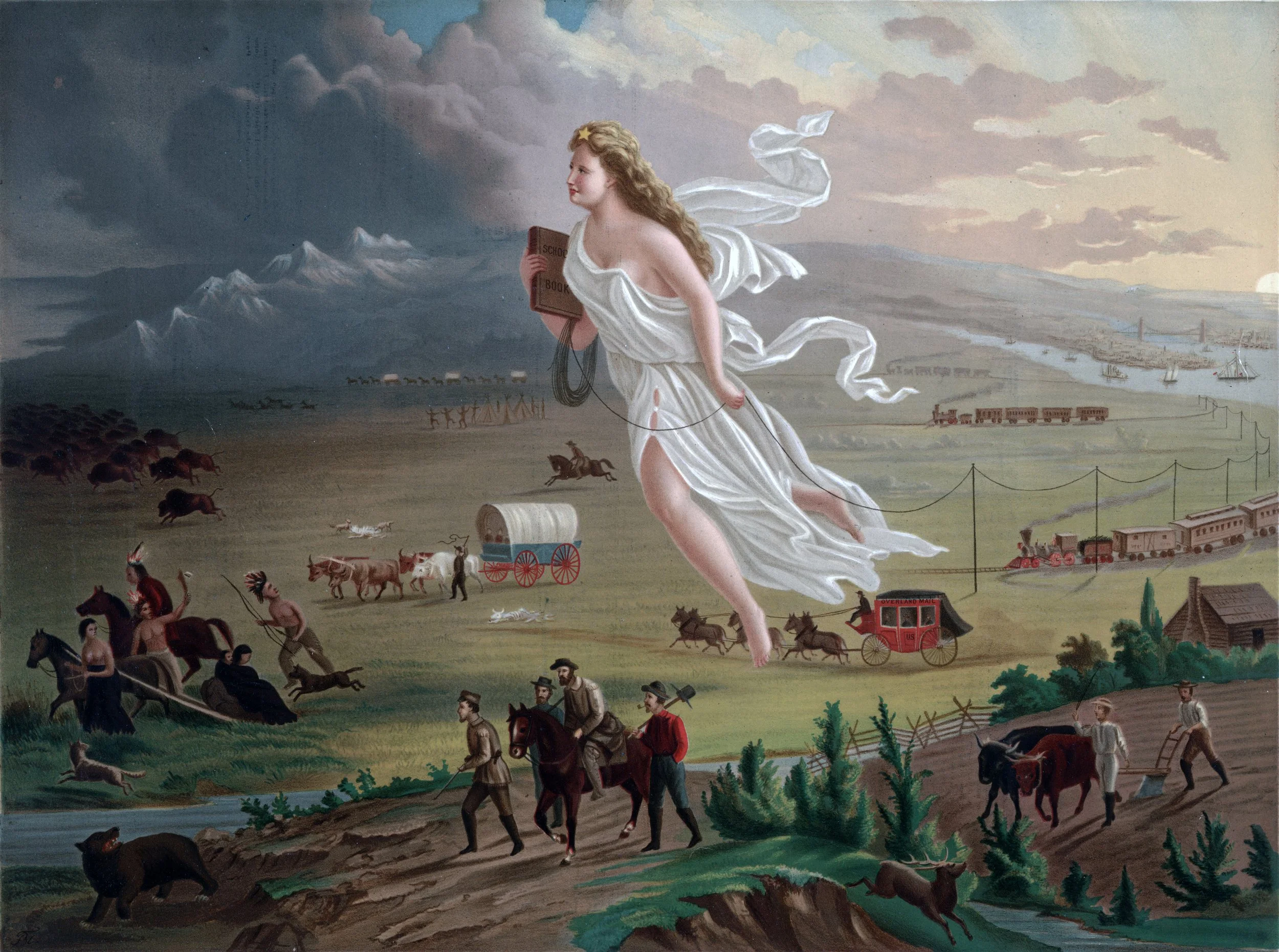
The 1872 painting American Progress by John Gast is bridled with rich and powerful symbolism; reflecting the reality of the Westward Expansion. John Gast uses elements such as color, form, contrast, and composition to create an epitome of the tragedies occurring within North America. The style of this painting signals that the artist is integrated into American society, adapting the composition and a certain sense of conformity into the key aspects of the painting, such as the portrayal of the evident injustice and sadness through the jurisdiction of the Native American Removal Act. The individual brush strokes make up a united sadness that transcends communities, almost empathizing with the hardship of every human being as an individual, capturing the lowest points and tireless labor seamlessly. This painting gives us a glimpse into this law from the standpoint of a person being rather than a territorial expansion we view and defend in a patriotic flash of vanity. Essentially, this work of art, seemingly typical for this era at first glance, captures both the agony and victorious clinks of glasses through a cruel toast as if the viewer was a spectator, an outsider belonging to neither side. Every bristle of the brush represents the sadness and agony of an aching body through grueling winters and sunrises that used to be a time of awe, now a representation of the start of a day in a life unwanted by their own self. Exploring the minute details of this painting, repeatedly cutting it into tinier and tinier pieces parallel to the land considered sacred through Native Americans, the symbolic meanings of this art will be dissected.
Firstly, a part of the painting that stands out is the juxtaposition of colors, the separation like water and oil representing the contrast, the divergence of both the cultures and geographical features alike. The dark represents the unfamiliarity of the new land, the conflicts they undergo rather than bring. It can represent a sick purification of the land, the petty refusal to live among those viewing the concepts and laws of nature above a modernized government, or the deepest sorrows and heartbreaks brought to the surface through dark and haunting colors. Similarly, the usage of color and form referring to the clouds in the background directly illustrate the colonization, a metaphor of the eventual clearing of the sky correlating to the perpetual downfall of the Native American culture. The temporary dark clouds will rain ultimately, this feature in the painting embodying the last desperate breath of Native society and peaceful living before being reduced to specks on a map, an entire culture reduced to an esoteric group. Fully blended brush strokes symbolize a developed society, afraid of imperfections and divergence from their “advanced” culture.
Some confirmed historical events are depicted in this painting, including war strategies such killing off buffalo to drive the Native Americans westward and the physical displacement of the Natives can be seen in the background. You can also see the influence on technology as an aftereffect of American expansion, visible through trains and waterways in the background.
Touching off on the contrasting colors, these can be interpreted in several ways, especially dealing with the angelic figure. The contrast between the dark colored book and the angel’s light colors guides the reader’s eye for it to be the first thing they notice, symbolizing that the more “seen” society is America. The results of several studies concludes that when presented with 2 choices, the first one is the one the viewer considers the most; the reader’s gaze is re-captured repeatedly and drawn to the contrast. This may illustrate the American dismissal of the fact that the Natives are one of the rare societies longing for peace amongst power-driven countries, blinded with an overwhelming and mind-numbing patriotic movement. Along with this, the dark color of the book against white fabric brings the socioeconomic inequality and flaws in republicanism to light.
